

Pickleball's biggest crossover showcase delivered exactly what the sport wanted: star power, real competition, and a prime-time ESPN stage. At Pickleball Slam 4, Andre Agassi and James Blake outlasted Anna Leigh Waters and Genie Bouchard in front of a lively crowd at Hard Rock Live, giving the event its strongest mainstream moment yet. This week, we break down the full result — including the scorelines that mattered — and then turn to a second theme every serious player should care about: how to protect your body so the game you love does not shorten the athletic life you still have ahead of you.
We are also focusing on the movement problems driving today's most common pickleball injuries. New medical and sports-medicine coverage keeps pointing to the same conclusion: many players think about injuries only after the swing, when the bigger danger often begins with the first emergency step, the late backpedal, or the overloaded Achilles. If you want to play better, play longer, and truly play for life, this issue is built for you.
Let's get into it.
HEADLINES
TEAM AGASSI WINS PICKLEBALL SLAM 4 ON ESPN: Andre Agassi and James Blake beat Anna Leigh Waters and Genie Bouchard in the sport's highest-profile made-for-TV event, staged at Hard Rock Live in Hollywood, Florida. Waters took the opening singles contest over Blake, Agassi answered against Bouchard, and Team Agassi closed the night by sweeping mixed doubles to secure the overall win. Read the recap →
JOOLA'S PATENT FIGHT JUST GOT REAL: JOOLA formally launched patent infringement litigation against 11 paddle brands, taking its propulsion-core dispute to the International Trade Commission and raising the possibility of major ripple effects across the paddle market. Read the latest →
SACRAMENTO BECOMES A CRITICAL STOP IN THE PPA RACE: The Fasenra Sacramento Open features more than 900 pro and amateur players, 1,000 ranking points for gold medalists, and mounting pressure as players chase the last qualifying spots for the PPA Finals. Official storylines →
THE SLAM GOES PRIME TIME: Agassi and Blake Beat Waters and Bouchard in Pickleball's Biggest Made-for-TV Night
Pickleball Slam 4 was designed as a spectacle, but the result was more than a celebrity exhibition. On April 15, at Hard Rock Live at Seminole Hard Rock Hotel & Casino Hollywood, Andre Agassi and James Blake defeated Anna Leigh Waters and Genie Bouchard in front of a near-capacity crowd and a national ESPN audience, taking the event by a 3–1 running tally in the night's match segments. The official event site promoted the evening around a $1 million purse, while Sports Business Journal reported that the total pool covered both appearance fees and prize money rather than a publicly broken-out winner's share.
The night began with the matchup that most closely resembled a real measuring stick for the sport: Anna Leigh Waters against James Blake in singles. Blake's forehand pressure created problems early, but Waters did what great champions do — she adjusted fast, reclaimed control, and won 15–13, 15–5. That gave the women early momentum and energized a crowd that, according to Pickleball.com's recap, leaned noticeably toward Waters and Bouchard from the opening points.
Agassi then stabilized the evening for Team Agassi by beating Bouchard 15–4, 11–15, 15–6. The key moment in that match was Bouchard's second-game push: instead of being overwhelmed by Agassi's experience, she forced a third game and made the event feel competitive rather than ceremonial. That mattered. One of the recurring criticisms of crossover pickleball events is that they can feel pre-scripted. This one did not.
The deciding stretch came in mixed doubles, played to 21. Agassi and Blake took the first game 25–23 in what was described as the night's most entertaining sequence — long rallies, sharp dink exchanges, Waters mixing in occasional lob serves, and just enough net-cord chaos to keep the arena buzzing. They then closed the second game 21–16 to lock down the win. Agassi later admitted the tactical priority was simple: keep the ball away from Waters as much as possible. That alone tells you how much respect the tennis legends had for the best player on the court.
So what did Slam 4 actually prove? First, it showed that pickleball's strongest television product is no longer just retired tennis nostalgia. The 2026 edition deliberately moved closer to authentic pickleball relevance by putting Anna Leigh Waters — the sport's dominant competitive figure — at the center of the show. Second, it confirmed that the sport still benefits from star crossover when the production, personalities, and stakes are big enough. And third, it suggested that the future of these tentpole events may be larger than one annual made-for-TV novelty. Sports Business Journal reported that the event was close to selling out its roughly 3,500-seat venue, carried 14 sponsors, and is already being discussed as a brand that could expand internationally. That is not just a fun night on cable. It is a business signal.
What it means for the sport: Slam 4 worked because it blended genuine pickleball credibility with mainstream entertainment packaging. Waters validated the competition. Agassi and Blake validated the crossover. ESPN validated the audience. For a sport still trying to convert curiosity into durable fandom, that combination matters.
PLAY FOR LIFE: Why Pickleball Injuries Often Start Before the Swing

One of the most useful injury-prevention insights circulating right now is also one of the least intuitive: many pickleball injuries do not begin when you hit the ball. They begin one step earlier, when you realize you are out of position and try to save the point with a violent first move. That is the central takeaway from recent guidance by Houston Methodist, which argues that the dangerous moment for many players is the emergency push-off — not the stroke itself.
For players who care about longevity, the implication is clear: footwork is preventive medicine. Earlier reads, smaller adjustment steps, better diagonal movement, and more balanced body positioning do not just improve consistency; they reduce the chaotic force spikes that create injury risk. In other words, better pickleball mechanics are often better orthopedic mechanics too.
That perspective also fits the broader injury data coming out of recent orthopedic literature. A 2026 cross-sectional study published in Injury Epidemiology reviewed 164 pickleball-related injury cases at a tertiary academic center and found that the sport's injury burden reaches far beyond simple slips and falls. Elbow, shoulder, wrist, Achilles, knee, spine, and hip injuries all showed up in meaningful ways. For aging athletes and returning weekend warriors alike, that is the real warning: pickleball is wonderfully accessible, but it still punishes rushed movement and poor preparation.
Longevity takeaway: If you want to stay on the court for the next ten years, train your first step, not just your third-shot drop. Efficient movement is one of the best forms of injury prevention available to recreational players.
ACHILLES ALERT: The Lower-Leg Problem Recreational Players Cannot Ignore
If there is one injury trend that deserves more attention from pickleball players over 40, it is the growing number of foot-and-ankle problems tied to explosive movement. McGovern Medical School's March 2026 guidance on pickleball foot and ankle injuries is especially blunt: orthopedic specialists are seeing a sharp rise in ankle sprains, Achilles tendon problems, plantar fasciitis, and stress-related overload issues as more adults return to court sports through pickleball.
The reason is simple. Pickleball looks friendly, but it asks for sudden lateral bursts, hard pivots, rapid acceleration, and repeated push-offs from awkward positions. Those demands place stress on the ankle ligaments, calf complex, plantar fascia, and Achilles tendon — especially in players who arrive under-trained, wear the wrong shoes, or ramp up volume too quickly after years away from explosive sports.
The Achilles deserves special respect. Early Achilles trouble often starts as heel pain, morning stiffness, or calf tightness that players try to play through. That is the wrong instinct. The warning signs matter because once the tendon is overloaded, the next step can become the memorable one: the sudden pop in the back of the leg that feels, as orthopedic surgeons often describe it, like being kicked from behind by nobody at all. When that happens, the match is over — and sometimes the season is too.
The prevention framework is refreshingly practical. Warm up with light cardio and dynamic mobility before play. Wear true court shoes with lateral stability rather than running shoes. Build court volume gradually instead of jumping into back-to-back marathon sessions. Strengthen the calves and work on balance. Most importantly, treat heel and Achilles discomfort as early information, not background noise. The players who stay active longest are usually the ones who respond sooner, not tougher.
The bottom line: Pickleball is low barrier, not low demand. If your lower legs are not prepared for acceleration, deceleration, and side-to-side force, the court will expose it.
THE BUCKET LIST: GLOBAL COURTS

01 — Sandals South Coast, Jamaica: If your dream pickleball trip includes adults-only Caribbean luxury, all-inclusive ease, and a serious amount of court time, Sandals South Coast is one of the strongest bucket-list options in the sport right now. Sandals' official pickleball program now spans 64 courts across 14 resorts and positions the company as the first official all-inclusive resort partner of USA Pickleball. South Coast stands out with 12 dedicated courts, daily open play, lighted evening sessions, USA Pickleball-approved equipment, intro programming, and coaching options layered into a beachfront Jamaica experience that still feels unmistakably upscale.
INSIDER TIP: REHEARSE THE FIRST STEP BEFORE YOU PLAY
Before your next session, spend two minutes practicing nothing but your emergency movement pattern. Start in ready position, then react to an imaginary wide ball by taking one small directional step and two quick adjustment steps instead of one giant panic lunge. Repeat to both sides ten times. This simple pre-play rehearsal teaches your body to move earlier and more efficiently, which can reduce overload on the Achilles, hamstrings, and knees before the first real point even starts.
VIDEO OF THE WEEK
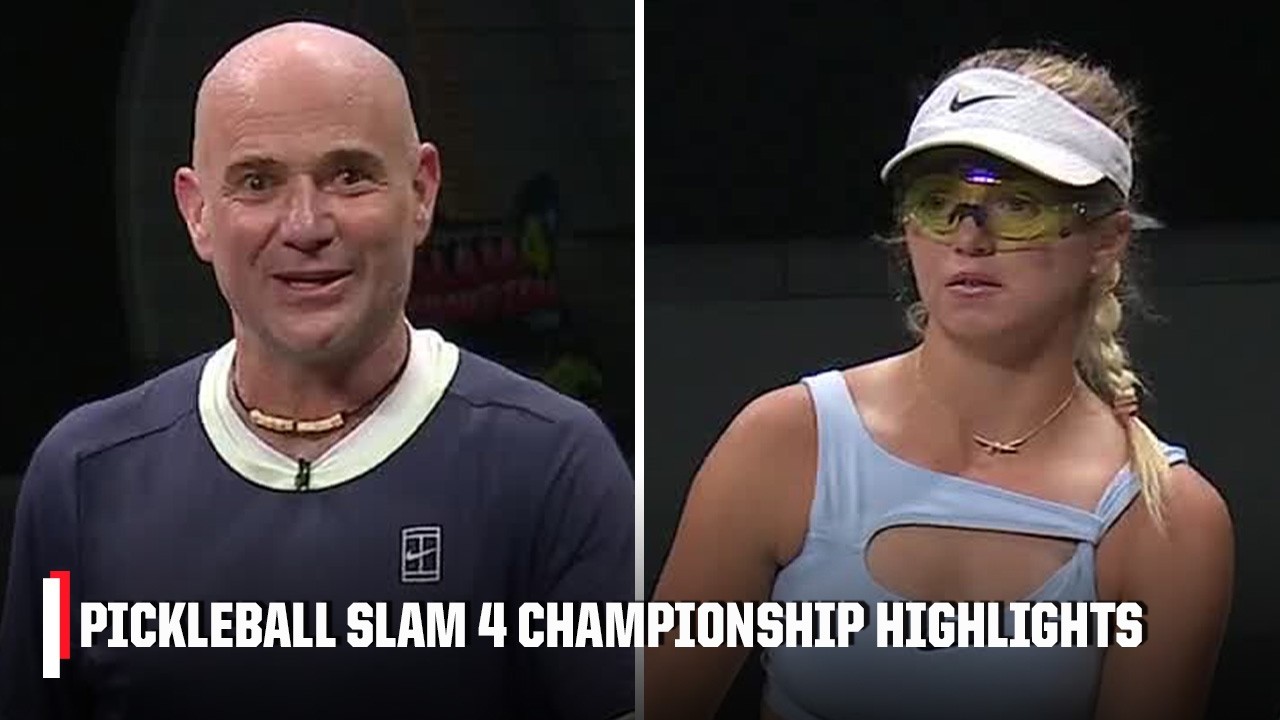
If you missed the event — or just want the condensed version without the between-point filler — ESPN's 23-minute highlight package is the cleanest watch of the week. It captures Waters' opening singles win, Agassi's response against Bouchard, and the momentum swings that made the mixed doubles finish feel bigger than a novelty exhibition. At the time of verification, the video was already drawing more than 300,000 views in just a few days. Watch on YouTube →
WHAT WE'RE COVETING
THE TRAINING AID: Enhance Dink Master 3.0 — $299.99

This week's gear pick is not a paddle. It is a training tool that fits the entire issue's theme: improve your game in a way that is repeatable, efficient, and easier on the body than playing six extra pickup games when you are already fatigued. The Dink Master 3.0 product page currently lists the board at $299.99, with a detachable mini net, dual rebound surfaces, and a free drill library included. If you want more quality reps without depending on court availability, it is one of the more interesting training buys in the category. Shop with the verified Enhance affiliate link →
See you on the court,
The Pulse of Pickleball Team
Questions or feedback? [email protected]